

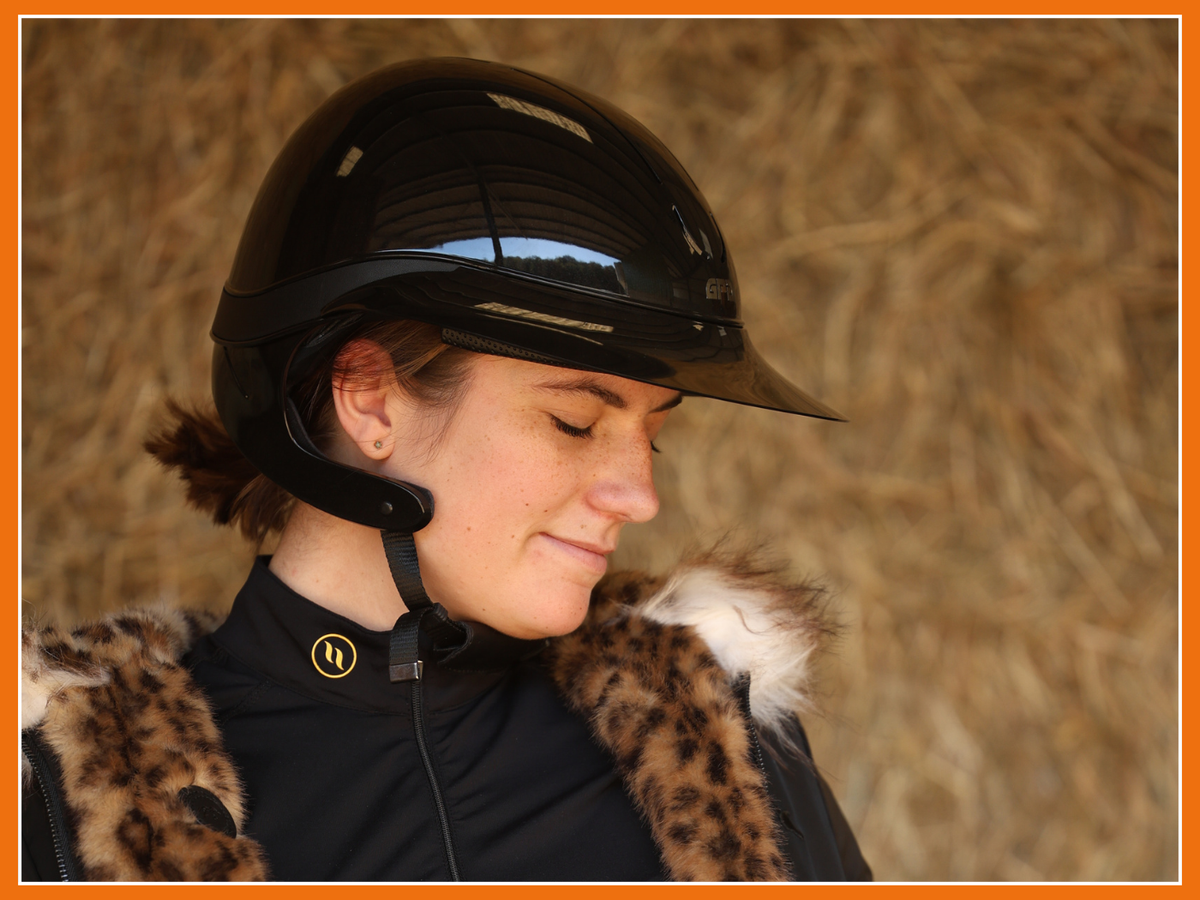
How to choose a riding helmet?
It’s the first piece of equipment we buy… and one we should never choose lightly. A riding helmet protects what matters most, every time you ride, whether in the arena or out on the trail. 🧡
With dozens of models, standards and brim styles to choose from, it’s easy to feel overwhelmed. Should you focus on weight, ventilation or price? How can you tell if a helmet fits properly? At OHLALA, we help riders make these choices every day. Here’s our step-by-step guide to finding a helmet that truly protects you.
In brief: how to choose a riding helmet
To choose the right riding helmet, check these five things in order:
- Size: measure your head circumference in centimeters, 2 cm above your eyebrows.
- The fit: the helmet stays in place without the chinstrap when you tilt your head, with no pressure points.
- Adjustment: rear dial and chinstrap fitted with room for one finger beneath your chin.
- Comfort: ventilation, weight, removable padding and a brim suited to the way you ride.
A helmet that has taken a significant impact in a fall must be replaced, even if there’s no visible damage.
How to find the right riding helmet size
Your riding helmet size corresponds to your head circumference in centimeters. A helmet that’s too large can shift in a fall; one that’s too small can cause headaches and won’t sit correctly.
Measure your head circumference in 3 steps
- Use a flexible measuring tape (or a piece of string and a ruler).
- Place it about 2 cm above your eyebrows, above your ears, and around the widest part of the back of your head.
- Read the measurement without pulling the tape tight. Between sizes? Try both: the shell’s shape matters as much as the number.
The at-home fit test
- Put on the helmet without fastening the chinstrap, with the brim about two finger-widths above your eyebrows.
- Tilt your head forward, then from side to side: the helmet should move with your head without slipping.
- Keep it on for 5 to 10 minutes: you shouldn’t feel any pressure points on your forehead or temples.
- If you ride with a bun or hairnet, try the helmet on with your hair styled as it is when you ride.
Round or oval head shape? Every brand has its own shell shape. Some heads are rounder, while others are longer from front to back. If a helmet presses on your forehead but feels loose at the sides, the issue is shape, not size: try a different model rather than a different size.
💡 If you’re unsure, feel free to email us at hello@ohlala-equestrian.com.
How to adjust your riding helmet properly
Even a well-chosen helmet loses much of its effectiveness if it isn’t adjusted properly. Check these four fit points before every ride.
- Position: the helmet should sit level, neither tilted back nor pulled down over your eyes. The brim should be about two finger-widths above your eyebrows.
- The rear adjustment dial: if your helmet has one, tighten it until the fit is secure but comfortable. The Uvex Exxeed Pro and Riding World Topy are two examples.
- The chinstrap: once fastened, you should be able to slip one finger between the strap and your chin. You should be able to open your mouth, but the helmet should move down slightly when you do.
⚠️ Never ride with your chinstrap unfastened, even for a few minutes at a walk: it keeps your helmet in place during a fall.
Ventilation and liners: the keys to comfort
A comfortable helmet is one you barely notice wearing—and one you’ll keep wearing. Three features make all the difference day to day.
Ventilation. Front and rear vents (grilles, perforated panels, and internal channels) help release heat. Essential if you ride often in summer or outdoors. The KEP Cromo 2.0 stands out for its Air Control ventilation system, which lets you adjust the air inlets manually to suit the weather and how hard you’re riding.
The inner liner. Look for one that’s removable and washable. You can take it out and machine-wash it at 30 °C. A real plus for hygiene!
Brim, technology and finish: refine your choice
Once you’ve checked the standard, size and comfort, it’s time for the details that make a helmet feel truly yours.
Which brim should you choose?
|
Brim style |
Who is it for? |
Explore the selection |
|---|---|---|
|
Standard |
Versatile, for all kinds of riding and every discipline |
|
|
Polo (wide) |
Offers better sun protection; especially popular for outdoor riding and show jumping |
|
|
Interchangeable |
One helmet, different looks or uses throughout the seasons |
|
|
Brimless |
Unobstructed field of vision; often worn with a helmet cover for cross-country |
Rotational impact protection. In a fall, the head often takes an angled impact that causes the brain to rotate inside the skull. Systems such as MIPS use a low-friction layer inside the helmet to reduce these rotational forces. The Flex On Armet Star MIPS with Angel visor, priced at €510, is one example.
The finish. Matte, glossy, chrome, carbon, patent leather… Your choice of finish comes down to taste, but also upkeep: fingerprints can show more readily on a glossy helmet. For competition outfits, Antarès Sellier offers helmets made in France with exceptionally refined finishes.
Women’s, men’s and kids’ helmets: what’s the difference?
The safety standard and level of protection are the same for everyone. What differs is the shell shape, available sizes and a few practical details.
Adult riding helmets: styles for everyone. Riding helmets aren’t necessarily gender-specific: most styles suit both women and men. Choose based on the shell shape, style, finish and visor you prefer (standard, wide or hybrid). Explore our full range of riding helmets
Children’s riding helmets. For a child, look for a lightweight helmet with an easy-to-use fastening and a design they’ll want to wear. Don’t buy a size up for them to grow into: a helmet that’s too large won’t provide proper protection. Explore our full range of children’s helmets
OHLALA’s picks by budget
|
Budget |
Model |
Why we love it |
|---|---|---|
|
Under €50 |
Riding World Topy, matte black — €29.99 |
EN 1384:2023 standard, adjustment dial, washable padding: ideal for beginners |
|
Under €100 |
Equithème Pepit — from €83.30 |
Matte shell, metallic insert, front ventilation |
|
Under €150 |
Equithème Soazy — €128.99 |
EN 1384:2023 certified, with ventilation built into the front insert |
Care and replacement: when should you change your helmet?
A riding helmet should be replaced in three situations:
1️⃣ After a fall involving a blow to the head
2️⃣ After a significant impact, such as the helmet falling hard onto the ground
3️⃣ After about five years of use. Manufacturers recommend replacing a helmet even if there’s no visible damage, as its impact-absorbing materials age over time.
How to care for your helmet
- Store your helmet away from heat—never on the rear shelf of a car in direct sunlight.
- Let it air dry after a wet ride, removing the padding if possible.
- Wash the padding according to the manufacturer’s instructions (often at 30 °C, without tumble-drying).
- Clean the shell with a soft cloth and warm water, without solvents.
- Carry it in a helmet bag to help prevent scratches and minor knocks.
Warning signs: a cracked shell, compressed or crumbling padding, a damaged chinstrap, a buckle that doesn’t fasten properly, or a helmet that moves when it used to fit securely.
FAQ: your questions about choosing a riding helmet
Which riding helmet should you choose as a beginner? Look for one with a dial adjustment and a washable liner. There’s no need to invest in a premium model right away.
How can I tell if my helmet is the right size? Put it on without fastening the chinstrap and tilt your head: it should stay in place without slipping or pressing on your forehead. The brim should sit about two finger-widths above your eyebrows.
Is a riding helmet required? Yes, in competition across all disciplines and at the vast majority of riding centers. Even when it isn’t required, wearing one is strongly recommended every time you ride.
Is the VG1 standard still valid? Yes, helmets certified to VG1 01.040 2014-12 are still accepted under many regulations. The latest standard, however, is EN 1384:2023: look for it when buying a new helmet.
Should you replace your helmet after a fall? Yes, if your head took an impact, even if there’s no visible crack. The inner materials can absorb that impact energy only once.
How long does a riding helmet last? About 5 years according to manufacturers’ recommendations, even if you haven’t fallen, as heat, sweat and time cause the materials to age.
Are women’s and men’s riding helmets really different? Not when it comes to safety. “Lady” models mainly differ in style and in the shape of the shell at the back, which makes room for a bun. Above all, choose a helmet that fits the shape of your head.
Conclusion
Choosing the right riding helmet means finding the right size and shape, then adjusting it for a secure fit. Style comes next, but it matters too: a helmet you love wearing is one you’ll wear every time. 🏇
Explore our full range of riding helmets, from your first lesson helmet to a competition-ready style. Not sure about the size or model? Dorine and Margaux are here to help via chat or at hello@ohlala-equestrian.com. 🧡