





Why is honey a star ingredient in horse care?
Honey has been used in traditional care for centuries, particularly for its useful properties in wound care. Its use in horse care is therefore more than a recent trend: certain characteristics of honey, including the environment it creates that is unfavorable to the growth of many microorganisms and its physicochemical properties, have attracted growing interest in wound healing.
Today, the properties of honey are being studied scientifically, particularly for its use in wound care. Certain honeys specifically selected and prepared for medical use can be included in appropriate care plans, provided they are used correctly and the wound’s progress is monitored. In winter, horses’ skin faces particular challenges: moisture, mud fever, clipping… In these conditions, honey-based products can be part of a suitable routine to care for the skin and wounds.
Horse skin: why a balanced skin microbiome matters
The skin is the body’s largest organ. It is home to millions of microorganisms (bacteria, fungi, and viruses) that make up the skin microbiome. These microorganisms play essential roles: they protect against pathogens, help break down certain natural substances, and help “train” the skin’s immune system. When healthy, they live in balance with the animal.
When the skin barrier is compromised, the balance between “good” and “bad” microbes is disrupted, which can contribute to skin problems. Several conditions may be linked, at least in part, to this imbalance:
- atopic dermatitis (skin allergies);
- skin infections;
- wounds that are slow to heal.
Restoring the skin barrier and rebalancing the microbiome are therefore key steps in managing skin problems.
What is Manuka honey, and what makes it so special?
Honey has been used for centuries to help repair skin. With antibiotic-resistant bacteria on the rise, its use in caring for wounds and skin infections in humans and animals is attracting renewed research interest and has become increasingly common in clinical settings.
Manuka honey is a monofloral honey made from the nectar of the Manuka shrub (Leptospermum scoparium), which is native to New Zealand. It contains several compounds that work together to attack microbes in multiple ways. This combined action makes resistance much less likely to develop.
The benefits of Manuka honey for horses’ skin
Antibacterial action on multiple fronts
Manuka honey works through several complementary mechanisms:
- A high sugar content (around 80%), which dehydrates bacteria through osmosis.
- High acidity (a pH of 3.2 to 4.5), which inhibits microbial growth.
- An enzyme that converts glucose into hydrogen peroxide, a natural antiseptic.
- Methylglyoxal (MGO), an antibacterial compound found in Manuka honey. Its concentration is closely linked to the honey’s antibacterial activity, measured by its UMF (Unique Manuka Factor) rating.
Studies have shown that Manuka honey is effective against Staphylococcus aureus and Pseudomonas aeruginosa, two bacteria commonly responsible for skin infections. It can also disrupt biofilms, clusters of bacteria that form a protective barrier and make infections difficult to treat.
Healing and soothing properties
Manuka honey contains antioxidants, flavonoids, phenolic acids, and enzymes that give it anti-inflammatory properties. It also supports the formation of new blood vessels and the growth of cells involved in healing.
A protective effect on the wound
Manuka honey maintains a healthy, moist environment that supports healing. It also aids debridement—the natural removal of dead tissue. This balanced environment improves the quality and speed of healing.
How does Absorbine use Manuka honey in the Silver Honey range?
Absorbine developed a skin care range called Silver Honey. It combines Manuka honey with silver microparticles in a patented ingredient, MicroSilver BG®, which helps protect and regenerate the skin through its antimicrobial and anti-inflammatory action.
Absorbine chose Manuka honey for two reasons: it has been the subject of numerous scientific studies, and its production and quality are regulated. Depending on the product, shea butter or essential oils enhance the soothing effect.
Which Absorbine products contain honey?
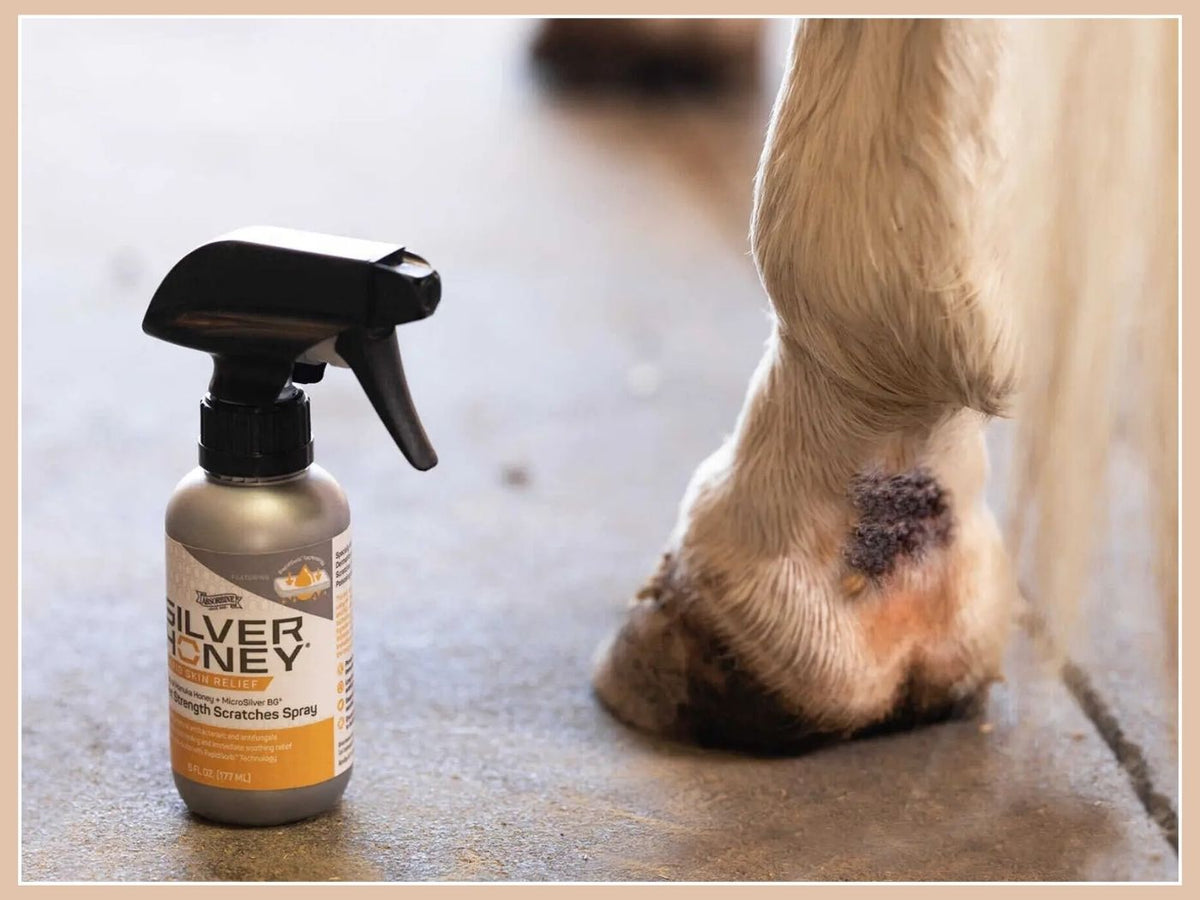
The Silver Honey range includes 4 products that can be used alone or together.
Silver Honey balm: versatile skin care
- The range’s signature product, designed to soothe and support healing.
- Enriched with shea butter to hydrate and soften the skin.
- Suitable for minor wounds, irritation, and rubs.
Silver Honey spray-gel: no-touch application
- The same base formula as the balm, in a spray-gel texture.
- Forms a protective layer on the skin.
- Touch-free application, ideal for sensitive areas or ticklish horses.
Silver Honey Mud Defense: targeted care for mud fever
- A formula specifically designed for mud fever (pastern dermatitis).
- Helps maintain skin integrity in wet, muddy conditions.
- Contains essential oils that soothe the skin and help keep your horse comfortable.
- RapidSorb™ technology for better penetration, even through scabs.
- Formulated specifically for horses.
Silver Honey dermatological shampoo: the foundation of the routine
- Use alone or before other Silver Honey products
- Gently cleanses and hydrates the skin while keeping it comfortable.
- Rich lather.
- Free from fragrance, dyes, parabens, sulfates, and alcohol.
How to add honey-based products to your horse’s winter care routine
Fall and winter can be hard on a horse’s skin: mud, rain, cold, and rubbing from blankets. Here’s how to use the range in different situations:
- Minor wounds, irritation, or rubbing from tack or blankets: Silver Honey balm is a must-have for your grooming trunk. Apply it as soon as you notice a minor sore.
- Mud fever or scabs around the pastern: use Silver Honey Mud Defense, designed for legs exposed to moisture.
- Dirty legs before treatment: first wash with Silver Honey dermatological shampoo, then dry thoroughly before applying the cream or Mud Defense.
- Sensitive areas or a horse reluctant to be touched: choose the spray-gel.
Frequently asked questions about Manuka honey and Silver Honey products
Do I need to disinfect a wound before every honey-based treatment?
No. You don’t need to disinfect the wound with an antiseptic such as Betadine® every time you treat it, as this can irritate the wound and slow healing. Disinfection is essential during the first few days; after that, applying a Silver Honey product to clean, dry skin is enough. For a serious wound or if you have any concerns, consult your veterinarian.
Will my horse lick the honey?
Generally, no. Silver Honey products have a bitter taste that discourages horses from licking them.
Can Silver Honey products be used on a foal?
Yes. Silver Honey products can be used on horses, mares, and foals.
Should you remove scabs when treating mud fever?
No, it isn’t recommended, as pulling off scabs can damage the skin. Thanks to RapidSorb™ technology, Silver Honey Mud Defense penetrates thickened skin and scabs.
How often should I apply a honey-based product to my horse?
Silver Honey products can be used daily until the skin’s condition improves.
What’s the difference between Manuka honey and regular honey?
Manuka honey contains methylglyoxal (MGO), an antibacterial compound not found in significant amounts in other honeys. Its activity is measured by its UMF rating, helping ensure consistent effectiveness.
Related products
You already have variants in your wishlist.


You already have variants in your wishlist.


You already have variants in your wishlist.

You already have variants in your wishlist.


